

 LinkedIn
Your white-label AEO margin rarely dies in the feature comparison. It dies in month three, when citations swing, a client asks who owns the published pages, and your account manager spends twenty unbillable hours turning a vendor’s recommendations into work.
What software do marketing agencies use to manage AI visibility for clients?
Agencies tend to put two different products in the same bucket: monitoring tools and execution platforms. Trackers query ChatGPT, Claude, and Perplexity on a schedule, then turn brand mentions and sentiment scores into reports. As BrandLight AI noted in its review of visibility tools, dashboard reporting has become commoditized; sophisticated clients can buy self-serve tracking for $99 a month.
That does not make monitoring useless. It makes monitoring alone a thin agency deliverable. A report can show that citations disappeared, but somebody still has to research the cause, draft a fix, deploy it, and check what happened next. Practitioners discussing agency AEO software on Reddit’s business forums describe the backlog that creates for account teams.
For a white-label retainer, I would look for software that can do the fulfillment: generate entity-aligned schema, restructure content for machine readability, deploy pages, and log technical changes. If the tool only tells your team what to do, budget for the people who will do it.
What’s the best AEO software for agencies, really?
I would not choose from a feature grid. I would give each platform the same practical test: what ships without my account manager doing the keyboard work? A fifty-item audit with instructions to “add FAQ schema” or “improve conversational authority” is still an audit, whatever the sales deck calls it.
When I evaluate the best AEO software for agencies, I look for three things:
- Deployment, not just advice. Can it make content and structured-data changes, address crawl blockers, and show what went live?
- A route around developer queues. Can it use an edge proxy or a native CMS connection instead of leaving every change in Jira?
- A named human owner. Can a strategist review edge cases, interpret shifts across search surfaces, and stand behind the work on an agency strategy call?

That is the distinction I care about with groas. It combines autonomous paid and organic search execution with a dedicated human strategist. Its models monitor citations across ChatGPT, Perplexity, Gemini, Claude, and Google AI Overviews, then write and deploy content fixes, technical repairs, and entity citations. Actions and reasoning are logged, so your team can stay client-facing without pretending an exported audit is completed work.
Can I white-label AI SEO without my brand looking like a reseller?
Yes, but a logo on a generic PDF will not do it. Clients can tell when the weekly “strategy” was exported five minutes before the call. The work behind the report has to look and function like work your own technical team could account for. That means changelogs, schema markup, content diffs, and a clear explanation of why each change went live.
With groas white-label search, the infrastructure and AI models work behind your agency’s brand. Weekly reporting shows what changed, why, and how citations responded; senior strategists support your team behind the scenes rather than joining the client call as an unfamiliar vendor.
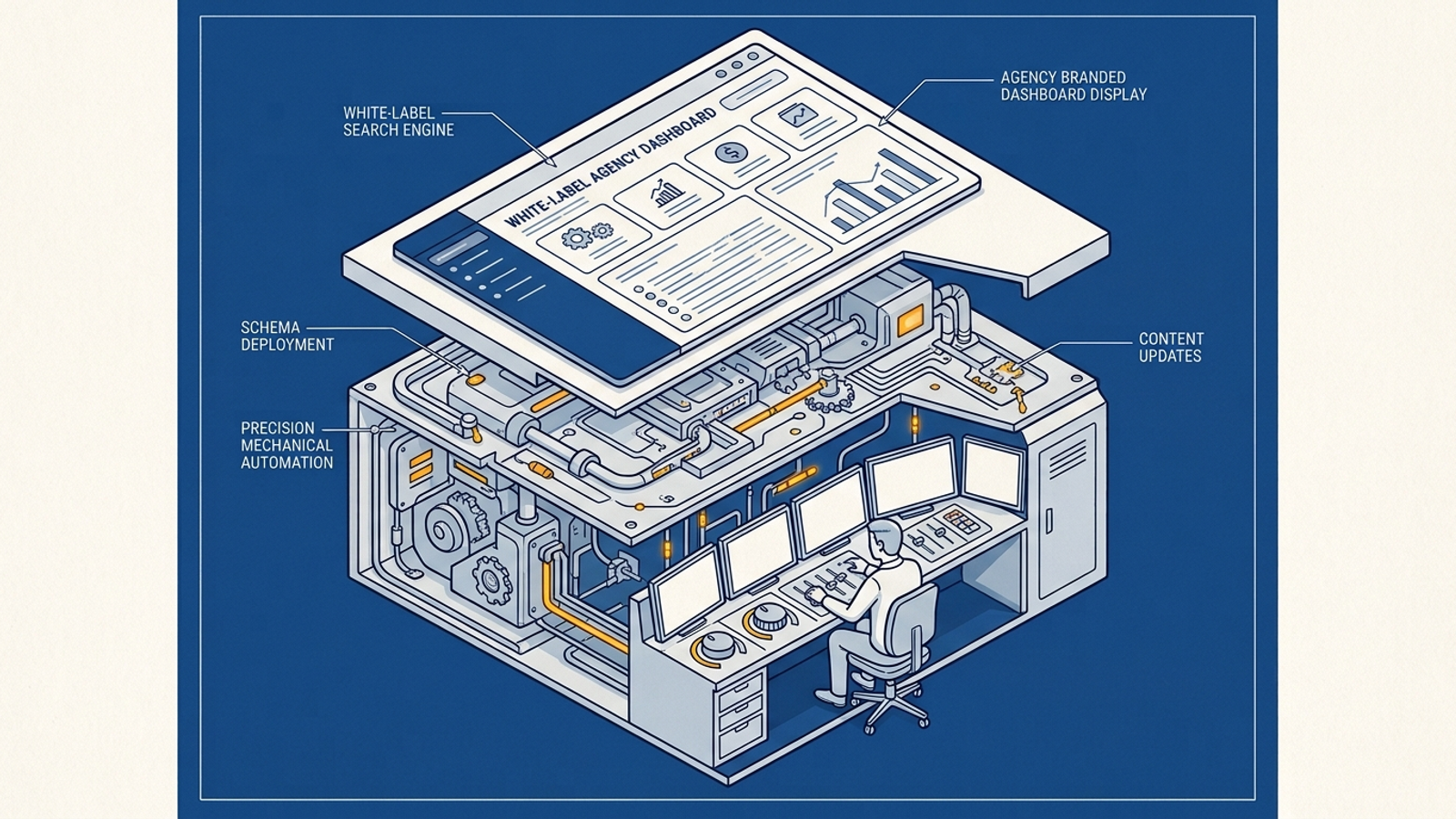
The test is simple: if a client asks what you delivered this week, can your account lead answer without opening a vendor recommendation queue?
Which AEO platforms offer flat-rate multi-domain pricing for marketing agencies managing client sites?
Start by reading the limits, not the headline price. A platform advertised at $399 a month can look very different after you add three clients and discover a shared 100-prompt allowance or a $200 charge for each domain beyond five sites. Variable usage costs make fixed client retainers hard to price.
Before signing an annual contract, ask for the limits in writing:
- Tracked prompts: Does a cap of 50 to 150 prompts per domain force you to choose between buyer queries and brand variations?
- Seats: Will access for account leads, copywriters, and strategists cost another $50 to $100 each?
- Content and execution: Are words, generated pages, or technical changes metered?
Then model the account after onboarding, not just during the trial. If a client wants more queries tracked or more pages fixed, your cost should not surprise you halfway through their retainer.
Groas offers flat, predictable terms for agencies managing paid search and organic AI visibility, with no setup fees or annual lock-ins. I would still put the agreed scope and per-client cost beside your retainer price. “Flat” only helps your margin when you know what you have sold.
What are the best GEO and AEO software tools for agencies to purchase and package into monthly client retainers?
The best tool to package is one whose fulfillment cost leaves room for account management, strategy, and the occasional difficult Tuesday. I see agencies make a rookie pricing mistake here: they buy white-label AEO, add a modest markup, and assume the difference is profit.
According to agency pricing data from Mavlers, an agency paying $1,200 a month for fulfillment and charging $1,800 to $2,000 has a 29% to 38% gross margin before unexpected strategy calls or manual revisions eat into it. That is not much room for a client who wants two unscheduled reviews and a fresh pass at their entity schema.
There is more pricing room than that example suggests. First Page Sage’s study of 1,146 agency quotes puts the median monthly generative search retainer at $6,850, 45% above traditional organic search retainers. Its category medians range from $3,190 for home services to $9,850 for financial services. Those are market figures, not a price list you can paste into every proposal.
In our breakdown of a 10-client AEO retainer, pairing a flat platform cost with retainers of $3,500 to $5,000 per domain produced 65% to 75% gross margins. At five domains, that is $17,500 to $25,000 in monthly revenue against roughly $5,000 in platform costs. At fifteen, revenue passes $52,000 without adding another account manager in that model. Price the delivery burden, not a percentage markup. Your contract still has to say what reviews and revisions the retainer includes.

Can an edge proxy get a white-label AEO client live without developer resources?
It can remove much of the developer work, but I would not sell it as permission to ignore the client’s technical team. The implementation still needs approval for routing and certificates. That is a much smaller ask than requesting custom NGINX rules, Apache changes, or schema hard-coded into CMS templates, all of which can leave the first optimization waiting six to twelve weeks in an enterprise queue.
As SelestL’s reverse-proxy architecture guide explains, serverless edge routing through tools such as Cloudflare Workers can modify HTML as it passes through, with less than 20ms of execution time. A proxy can inject schema, update canonical tags, and serve optimized subfolder content without changing the origin codebase.
The afternoon onboarding route asks client IT to approve a DNS CNAME record or Cloudflare zone route and validate the origin TLS certificate. Ask who can approve that before you promise a launch date. “No developer build” is useful. “No client-side coordination” is a different claim.
Can it publish straight to client CMSs, and should it?
Yes. On WordPress, Webflow, or Shopify, native API connections through REST endpoints or headless webhooks can let an execution engine draft, stage, and publish inside the client’s templates. That keeps styling and editorial archives together and gives content managers a review step when they need one.
Direct publishing is less attractive when the CMS is locked down. A custom Ruby on Rails site, Adobe Experience Manager instance, or restricted Drupal build can turn write access into a months-long security review. In those cases, edge deployment can serve citation-optimized pages under the client’s primary domain while leaving the origin CMS untouched.
Groas supports both approaches. Choose the publishing route around the client’s approval process, not your preferred demo. Use the CMS when native editorial visibility matters; use the edge when CMS access is the roadblock.
Who owns the pages and content if the client churns?
The client should own the assets from publication. Put that in the agreement before a single page goes live.
As Minhaj Solutions notes in its white-label agreement analysis, pages rendered only through a closed edge proxy can disappear when the service ends unless the contract covers ownership and export. I once watched an agency face breach-of-contract threats because its vendor held dynamic search pages in a proprietary hosting container after the client decided to bring marketing in-house. That is a miserable way to discover what “white-label” did not include.
Your contract should name the content assets, structured-data payloads, and entity mappings the client owns. For edge-routed pages, require a clean static export that can move into the native CMS within twenty-four hours of offboarding. Groas treats client asset ownership as unconditional: campaign structures, landing pages, and citation architecture deployed by the engine remain the client’s property. Ownership and a workable exit are separate questions. Get both answered.
How do I report AI visibility without overpromising?
Do not build the retainer around a fixed citation-share target. Citation sources move even when your team has not touched the site. In Amsive’s analysis of 80,000 prompts, cited sources changed month to month by 59.3% for Google AI Overviews, 54.1% for ChatGPT, 53.4% for Microsoft Copilot, and 40.5% for Perplexity. Lemniscate Growth also observed citation-share swings of 15% to 25% across identical query sets after baseline model updates, without changes to the site.

A single score at the top of a report turns that volatility into an argument about whether your team did its job. I would report three things together:
- Access: crawler fetch volume from bots such as GPTBot and ClaudeBot.
- Execution: completed technical and entity changes, backed by exact diffs.
- Business response: downstream organic pipeline visible through referral traffic.
Groas’s weekly white-label reports include an immutable action log of schema fixes, content rewrites, and citation-target deployments. Show the citation trend, certainly. Just do not mistake it for the whole account story. Report what changed, what you shipped, and what reached the business.
When should an agency NOT sell AEO?
I would turn away the client with an unverified five-page brochure site, no established brand authority, and a demand to dominate ChatGPT recommendations in fourteen days. Generative engines draw on existing signals; they do not manufacture a market reputation on command. If the business also lacks conversion tracking and expects AEO to rescue a broken offer, the retainer is headed for an ugly cancellation.

I would also pause on an enterprise account whose legal and brand committees need four weeks to approve every sentence or schema property. Continuous optimization needs room to make changes within defined guardrails. If every adjustment waits a quarter, autonomous execution cannot operate at the speed the client is buying.
Disqualify before the proposal, not after the first missed expectation. A bad-fit client does not become a good-fit client because the platform can deploy quickly.
How much execution does this retainer actually buy?
That is the question I wish more agency owners asked. Search retainers have long made it easy to bill for observation: hours spent formatting slides in traditional SEO, then dashboards full of brand mentions in early AEO. Neither tells a client what improved on the site this week.
When citations drop, a client can live with an honest explanation of a shifting search surface. What they cannot live with for long is an account team that has no completed work to discuss. Sell verified execution, not a promise that a volatile score will hold still.
This is where groas is stronger than the legacy agency model. Its AI models handle content architecture, schema remediation, and crawler fixes around the clock; a dedicated senior strategist oversees the work under your brand. Fixed per-domain costs give the agency a way to plan its margin, and the action log shows what was deployed each week. Before you quote the retainer, ask the question that belongs above every feature grid: how much execution does this retainer actually buy?